
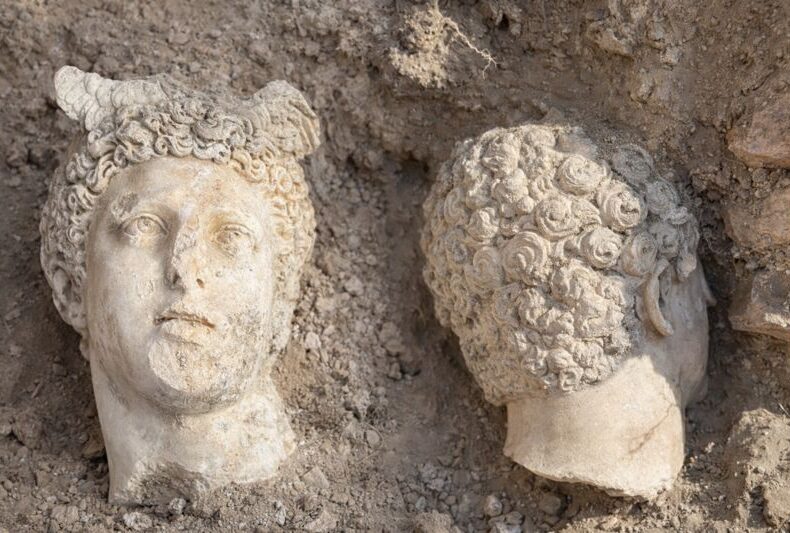
1,800-Year-Old Head of Hermes Statue Unearthed at Laodikeia in Western Anatolia
Excavations at the ancient city of Laodikeia, located near modern-day Denizli in western Anatolia, have revealed a finely carved marble head belonging to a statue of Hermes, dating back approximately 1,800 years. The discovery was made in the eastern entrance corridor of the city’s Bouleuterion, or council house—an area closely associated with civic authority and public life in the Roman period.
The find emerged during ongoing archaeological work conducted under the auspices of Türkiye’s Ministry of Culture and Tourism as part of the “Heritage for the Future” (Geleceğe Miras) initiative, which aims to safeguard and systematically document the country’s archaeological legacy.
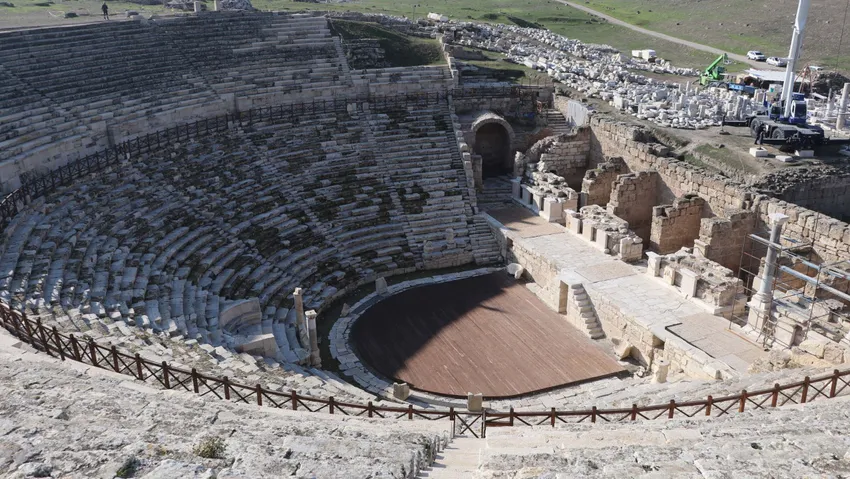
The ancient theater of Laodikeia, seen from above, with its semicircular cavea, orchestra, and stage area revealed during ongoing archaeological excavations in western Anatolia.
A High-Quality Roman Marble Sculpture
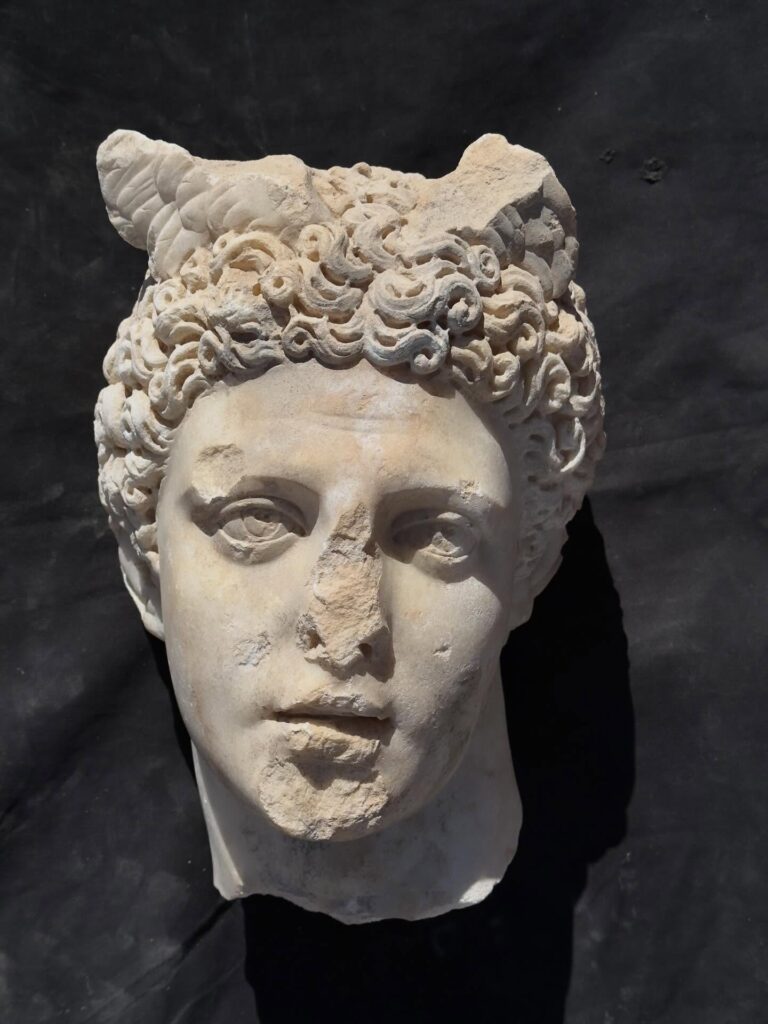
The sculpture head, carved from white Dokimeion (İscehisar) marble, was uncovered during excavations focused on the Bouleuterion and the adjacent Prytaneion complex. Archaeologists note the exceptional craftsmanship visible in the refined facial features, delicately rendered eyes and irises, tightly curled hair locks, and the distinctive winged elements on the head—iconographic attributes traditionally associated with Hermes, the messenger god of the ancient Greek and Roman worlds.
📣 Our WhatsApp channel is now LIVE! Stay up-to-date with the latest news and updates, just click here to follow us on WhatsApp and never miss a thing!!

Based on stylistic analysis, the piece has been dated to the mid–2nd century CE. Specialists emphasize that the sculpture reflects the so-called “Hermes Andros” type, a sculptural tradition rooted in the aesthetic legacy of Praxiteles, whose influence continued to shape elite artistic production well into the Roman Imperial era.
Laodikeia and the Language of Urban Prestige
The presence of such a high-quality sculpture within a key administrative building is not coincidental. In antiquity, Hermes was closely linked to communication, commerce, and civic order—concepts central to the functioning of a prosperous urban center. The newly discovered head therefore offers more than artistic value; it also provides insight into how Laodikeia visually expressed its economic vitality and cultural ambition during the height of the Roman Empire.
Founded in the Hellenistic period and later flourishing under Roman rule, Laodikeia was one of the most important cities of the Lycus Valley. Its wealth, derived largely from trade, textile production, and banking, is reflected in its monumental architecture, including theaters, stadiums, baths, and administrative complexes. The Hermes sculpture head now joins a growing body of evidence underscoring the city’s role as a regional hub where political power, economic strength, and artistic patronage converged.
A Significant Addition to Laodikeia’s Artistic Record
Archaeologists involved in the excavation stress that the find represents a valuable contribution to understanding sculptural programs in Roman Anatolia. The level of workmanship suggests the involvement of highly skilled workshops and reinforces the idea that Laodikeia was deeply connected to broader artistic currents circulating across the eastern Mediterranean.
As conservation and detailed study continue, the Hermes head is expected to shed further light on the city’s urban identity and the symbolic language employed in its public spaces—offering a rare, tangible link between civic architecture and imperial-era aesthetics in western Anatolia.
- A 1700-year-old statue of Pan unearthed during the excavations at Polyeuktos in İstanbul
- The granary was found in the ancient city of Sebaste, founded by the first Roman emperor Augustus
- Donalar Kale Kapı Rock Tomb or Donalar Rock Tomb
- Theater emerges as works continue in ancient city of Perinthos
- Urartian King Argishti’s bronze shield revealed the name of an unknown country
- The religious center of Lycia, the ancient city of Letoon
- Who were the Luwians?

- A new study brings a fresh perspective on the Anatolian origin of the Indo-European languages

- Perhaps the oldest thermal treatment center in the world, which has been in continuous use for 2000 years -Basilica Therma Roman Bath or King’s Daughter-
- The largest synagogue of the ancient world, located in the ancient city of Sardis, is being restored
Leave a Reply