
A 4,000-Year-Old Silver Goblet Links Anatolia to the Earliest Visions of Cosmic Order
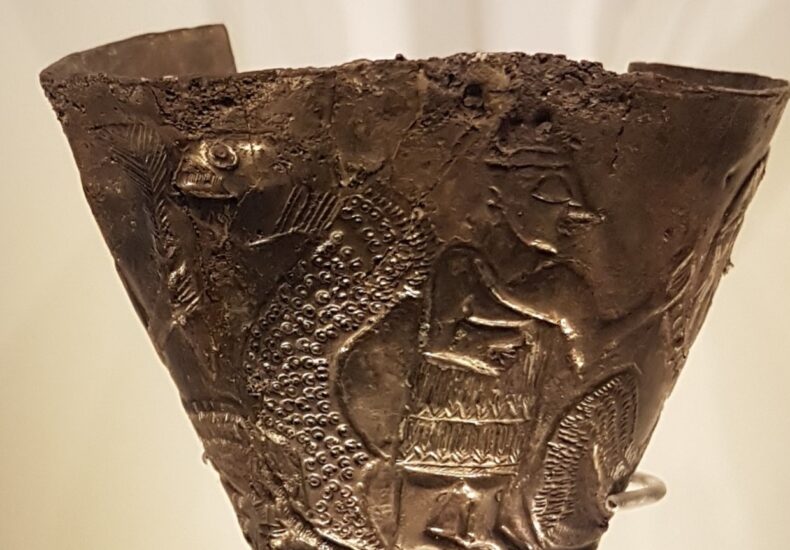
A small silver cup, unearthed decades ago in the Judean Hills, has returned to the center of scholarly debate—this time with Anatolia firmly in the discussion. Known as the ʿAin Samiya Goblet, the vessel dates to the Intermediate Bronze Age (ca. 2650–1950 BCE) and bears one of the most elaborate mythological compositions known from the period. New research now suggests that its imagery reflects an early, shared Near Eastern vision of how cosmic order emerged from primordial chaos—an idea with clear Anatolian connections.
An Exceptional Find from an Unassuming Burial
The goblet was discovered in 1970 near the spring of ʿAin Samiya, in the Judean Hills. Although the tomb itself contained mostly ordinary pottery and weapons, the small silver vessel stood apart immediately. To this day, it remains the only known luxury silver cup from this era recovered in the southern Levant
Its rarity alone would make it significant. Yet what truly sets the goblet apart is the dense narrative worked into its surface—imagery that has resisted straightforward interpretation for more than half a century.
Beyond Myth: Rethinking Creation Imagery
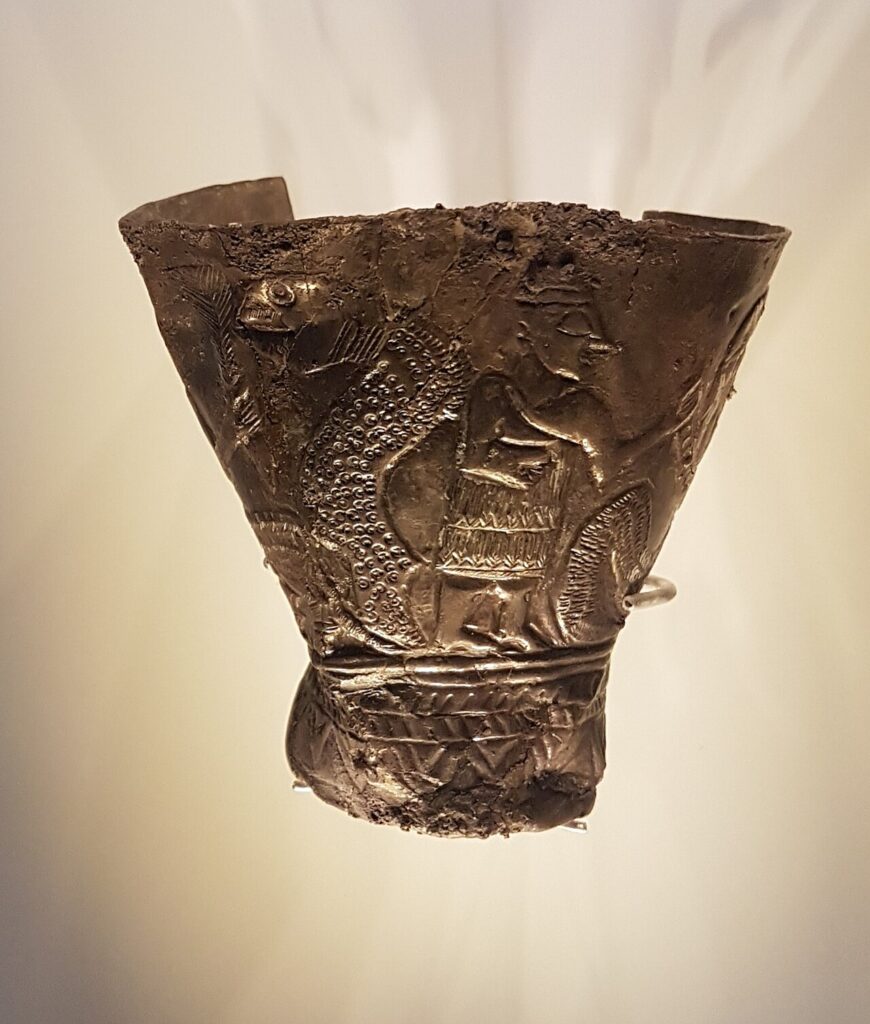
In a recent study, geoarchaeologist Eberhard Zangger and his colleagues challenge the long-held assumption that the goblet illustrates a specific Mesopotamian myth, most notably the Enuma Elish. Instead, they argue that the scenes express a far older and more universal concept: the transformation of an undifferentiated world into a structured cosmos.
📣 Our WhatsApp channel is now LIVE! Stay up-to-date with the latest news and updates, just click here to follow us on WhatsApp and never miss a thing!!
This reinterpretation carries particular weight because the goblet predates the written versions of Near Eastern creation myths by nearly a millennium.
Two Scenes, One Cosmic Narrative
The cup’s exterior displays two adjacent scenes in repoussé relief. In the first, hybrid figures—combining human, animal, and vegetal elements—appear entangled and unstable. Upright serpents and interwoven forms suggest a world in flux, before clear distinctions between humans, animals, plants, or even cosmic roles had fully emerged.
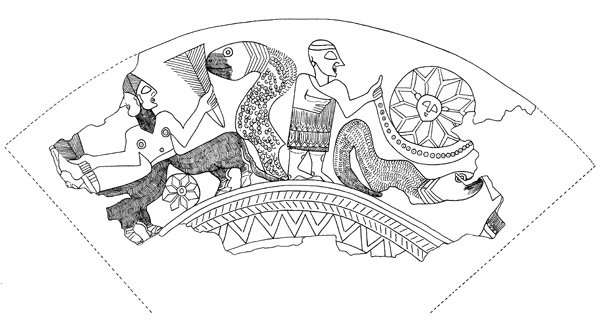
The second scene presents a striking contrast. Two human figures lift a crescent-shaped object enclosing a radiant solar disk. Below them, the serpent now lies horizontally, subdued. The researchers interpret the crescent as a “celestial boat,” a motif known across the ancient Near East, symbolizing the regulated movement of the sun and moon through the heavens.
Together, the images are read as a visual sequence: not a violent divine battle, but a gradual ordering of the universe.
Why Anatolia Matters
While the goblet was buried in the Judean Hills, the study emphasizes that its symbolic language was not confined to a single region. Comparative analysis points to strong parallels across Mesopotamia, Egypt, and crucially, Anatolia.
A key reference comes from Lidar Höyük in southeastern Türkiye, where a limestone prism bearing related celestial motifs has been documented. Though far simpler in execution, the object demonstrates that cosmological symbols circulated widely across Anatolia and northern Syria long before they appeared in canonical mythological texts.
Zangger’s team suggests that the conceptual design may have originated in southern Mesopotamia, while the goblet itself was likely produced in northern Syria—where access to silver was easier—before reaching the Levant via established trade networks that also linked Anatolia to the wider Near East.
Debate and Caution Among Scholars
Not all specialists are convinced. Zangger’s earlier work, including controversial hypotheses about Bronze Age civilizations, has made some researchers wary of far-reaching interpretations. Others point to unresolved questions surrounding the goblet’s restoration history and fragmentary condition, which complicate attempts to reconstruct a definitive narrative.
Still, even critics acknowledge the object’s extraordinary importance.
A Small Vessel with a Vast Horizon
Whether the ʿAin Samiya Goblet represents the birth of the universe, a funerary vision of renewal, or a shared cosmological worldview spanning Mesopotamia and Anatolia, it stands as one of the earliest known attempts to visualize humanity’s place within an ordered cosmos.
Four thousand years on, this modest silver cup continues to challenge modern assumptions—reminding us that some of the oldest ideas about the universe were shaped across interconnected landscapes that included Anatolia at their core.
Zangger, E., Sarlo, D., & Haas Dantes, F. (2025). The earliest cosmological depictions: Reconsidering the imagery on the ʿAin Samiya goblet. Journal of the Ancient Near Eastern Society “Ex Oriente Lux”, 49–66.
Cover Image Credit: Public Domain – Wikipedia Commons
- A 1700-year-old statue of Pan unearthed during the excavations at Polyeuktos in İstanbul
- The granary was found in the ancient city of Sebaste, founded by the first Roman emperor Augustus
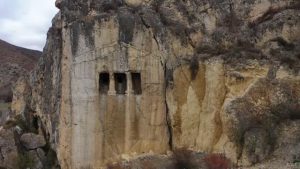
- Donalar Kale Kapı Rock Tomb or Donalar Rock Tomb
- Theater emerges as works continue in ancient city of Perinthos

- Urartian King Argishti’s bronze shield revealed the name of an unknown country
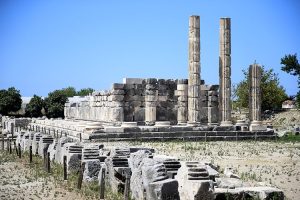
- The religious center of Lycia, the ancient city of Letoon
- Who were the Luwians?
- A new study brings a fresh perspective on the Anatolian origin of the Indo-European languages

- Perhaps the oldest thermal treatment center in the world, which has been in continuous use for 2000 years -Basilica Therma Roman Bath or King’s Daughter-
- The largest synagogue of the ancient world, located in the ancient city of Sardis, is being restored
Leave a Reply