
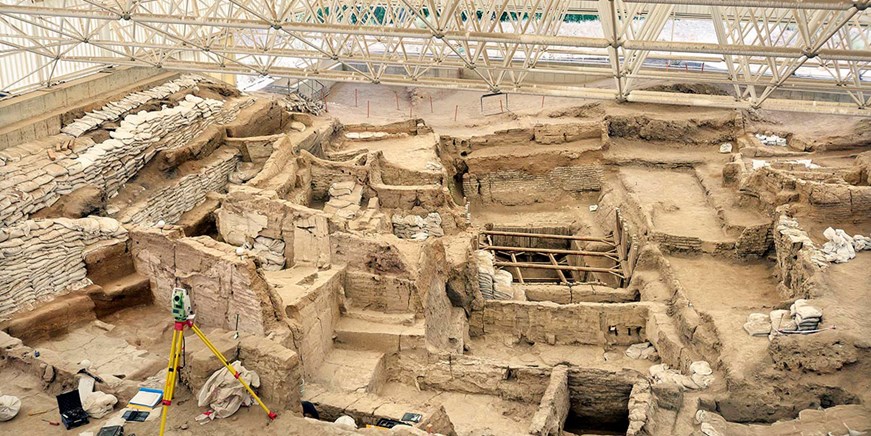
Çatalhöyük Study Wins Major Award in Poland: Turkish Scientists Help Redefine Neolithic Social Structure
A groundbreaking study on the Neolithic settlement of Çatalhöyük has received international recognition in Poland, after being selected as the most important foreign archaeological discovery of 2025 by Polish archaeologists. The award highlights research that challenges long-standing assumptions about social organization in early farming communities—placing women at the center of Neolithic life.
The distinction was awarded as part of the “Archeologiczne Sensacje 2025” (Archaeological Sensations 2025) competition, one of Poland’s most visible platforms for evaluating significant archaeological discoveries and research projects.
Why the Study Was Awarded
The jury recognized the Çatalhöyük research for its clear genetic evidence demonstrating matrilineal organization within Neolithic households. By analyzing 131 ancient genomes from individuals buried at the site, researchers identified kinship patterns that consistently followed the female line.
These findings suggest that women tended to remain within the settlement, while men were more mobile—a social dynamic that contradicts traditional models of male-dominated Neolithic societies. Instead, household continuity, ancestry, and spatial stability appear to have been structured around women.
📣 Our WhatsApp channel is now LIVE! Stay up-to-date with the latest news and updates, just click here to follow us on WhatsApp and never miss a thing!!
Research Led from Ankara, Built on International Collaboration
The awarded study was led by a genetics team headed by Prof. Mehmet Somel from Middle East Technical University and Hacettepe University. The project brought together geneticists, archaeologists, and physical anthropologists from multiple countries.
Key contributors included Prof. Arkadiusz Marciniak of the Adam Mickiewicz University, who has directed the Polish research mission at Çatalhöyük for more than 25 years, as well as geneticist and archaeologist Dr. Maciej Chyleński, also from Adam Mickiewicz University.
This long-term collaboration ensured that genetic data were interpreted directly within their archaeological and cultural context.
Published in Science, Echoing Beyond Archaeology
The study’s results were published in Science, giving the findings global visibility across disciplines. According to the competition jury, what set the research apart was not only its conclusions, but its methodological integration of ancient DNA with household archaeology.
Rather than treating genetics as a standalone dataset, the study used it to address fundamental questions about kinship, mobility, and social continuity in one of the world’s best-known Neolithic settlements.
Rethinking Neolithic Society at Çatalhöyük
Çatalhöyük has long served as a reference point for understanding early sedentary life. This new recognition reinforces its importance—not just as an archaeological site, but as a laboratory for re-evaluating how early societies were organized.
By placing women at the structural core of Neolithic households, the awarded research invites a broader reassessment of social models applied to early farming communities across Anatolia and beyond.
The Polish award confirms that Çatalhöyük continues to shape global debates on human prehistory—this time through a collaboration that bridges Anatolia, Poland, and the international scientific community.
- A 1700-year-old statue of Pan unearthed during the excavations at Polyeuktos in İstanbul
- The granary was found in the ancient city of Sebaste, founded by the first Roman emperor Augustus
- Donalar Kale Kapı Rock Tomb or Donalar Rock Tomb
- Theater emerges as works continue in ancient city of Perinthos
- Urartian King Argishti’s bronze shield revealed the name of an unknown country
- The religious center of Lycia, the ancient city of Letoon
- Who were the Luwians?
- A new study brings a fresh perspective on the Anatolian origin of the Indo-European languages

- Perhaps the oldest thermal treatment center in the world, which has been in continuous use for 2000 years -Basilica Therma Roman Bath or King’s Daughter-
- The largest synagogue of the ancient world, located in the ancient city of Sardis, is being restored
Leave a Reply