
In Midas’ Shadow? The Royal Phrygian Tumulus in Western Anatolia Is Reshaping the Power Map
For much of the last century, the political and ceremonial geography of Phrygia has been interpreted through a single focal point: Gordion. Long regarded as the unquestioned center of royal authority, the city shaped how scholars understood power, hierarchy, and elite identity in Iron Age Anatolia. A newly analyzed burial from western Anatolia, however, is now challenging that long-standing model.
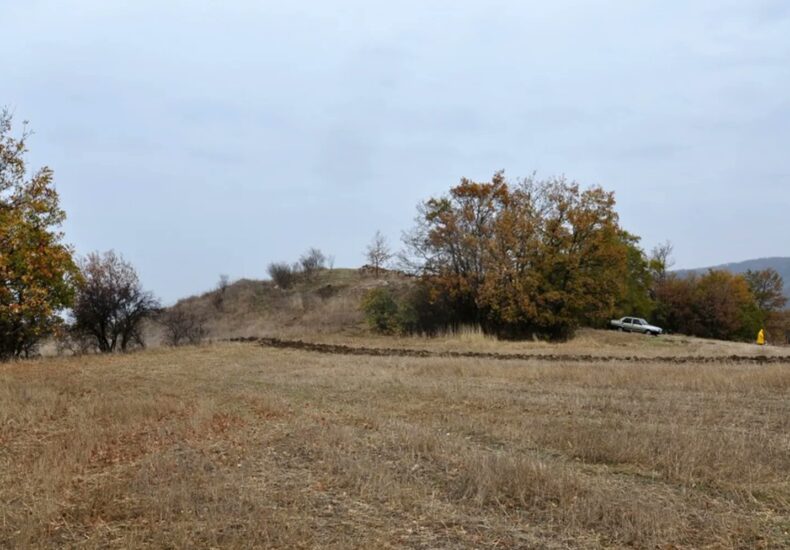
The Karaağaç Tumulus, located in today’s Bilecik province, has yielded a monumental 8th-century BC burial whose scale, architecture, and grave goods point to an individual closely connected to the highest levels of Phrygian power—possibly even to the family or inner circle of the legendary king Midas.
A Tomb That Exceeds Local Status
Set within a rural landscape far removed from Phrygia’s traditional political core, the Karaağaç Tumulus stands out for its ambition. The burial chamber was constructed from timber using techniques known from elite Phrygian contexts, and its overall layout reflects deliberate, monumental planning rather than local improvisation.
Such features are typically associated with the royal tumuli of Gordion. Their appearance at Karaağaç strongly suggests that the person buried here held a status far above that of a provincial aristocrat, occupying instead a privileged position within the broader Phrygian power structure.
📣 Our WhatsApp channel is now LIVE! Stay up-to-date with the latest news and updates, just click here to follow us on WhatsApp and never miss a thing!!
Elite Objects with Royal Parallels
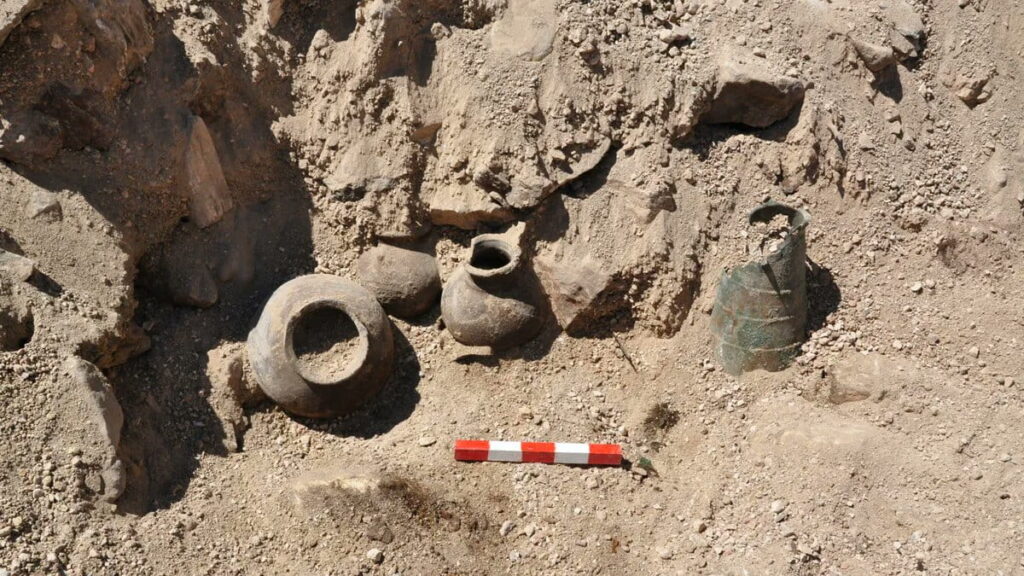
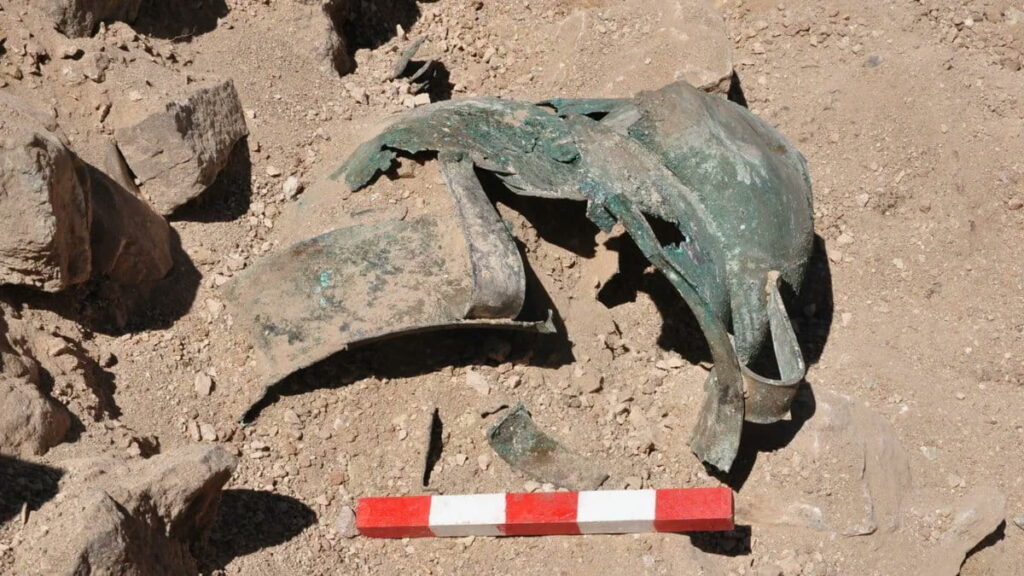
The grave goods reinforce this interpretation. Archaeologists recovered numerous ceramic vessels characteristic of Phrygian funerary practice, including one bearing a personal name inscribed in the Phrygian language. Even more striking is the presence of bronze vessels—objects that immediately signal elite status.
Among these are bronze situlae, decorated with procession and combat scenes. Until now, such vessels had been securely documented only in the famous Midas Tumulus at Gordion. Their appearance at Karaağaç represents a rare and significant expansion of the known distribution of royal-level material culture.
Power Beyond the Capital
Perhaps the most transformative implication of the Karaağaç discovery lies in its location. The tumulus is situated roughly 160 kilometers from Gordion, a distance that forces a reconsideration of how Phrygian authority was organized across space.
Rather than functioning as a rigidly centralized kingdom comparable to Assyria or Urartu, Phrygia may have operated through a more distributed system of power, in which elite families or high-ranking administrators exercised authority across multiple regions. The construction of a royal-scale tomb far from the capital suggests that political influence extended deep into the countryside, reshaping assumptions about Phrygian governance.
A Landscape of Memory Spanning Millennia
Archaeological evidence also indicates that the Karaağaç site was not used for a single burial event. The area includes an Early Bronze Age cemetery, the Phrygian-period elite tomb, and additional interments dating to later periods.
This long sequence of use transforms the tumulus into a key reference point for understanding how burial landscapes in central Anatolia were revisited, reinterpreted, and integrated into collective memory over nearly three thousand years.
From Regional Find to Global Debate
The study, led by Hüseyin Erpehlivan of Bilecik Şeyh Edebali University, was published in the January 2026 issue of the American Journal of Archaeology, bringing the Karaağaç Tumulus into international scholarly discussion.
More than an isolated discovery, the tomb invites a broader reassessment of Phrygian political geography. If royal authority could be expressed so clearly beyond Gordion, then the shadow of Midas—and the structure of Phrygian power itself—may have stretched much farther across Anatolia than previously imagined.
- A 1700-year-old statue of Pan unearthed during the excavations at Polyeuktos in İstanbul
- The granary was found in the ancient city of Sebaste, founded by the first Roman emperor Augustus
- Donalar Kale Kapı Rock Tomb or Donalar Rock Tomb
- Theater emerges as works continue in ancient city of Perinthos
- Urartian King Argishti’s bronze shield revealed the name of an unknown country
- The religious center of Lycia, the ancient city of Letoon
- Who were the Luwians?
- A new study brings a fresh perspective on the Anatolian origin of the Indo-European languages
- Perhaps the oldest thermal treatment center in the world, which has been in continuous use for 2000 years -Basilica Therma Roman Bath or King’s Daughter-
- The largest synagogue of the ancient world, located in the ancient city of Sardis, is being restored
Leave a Reply