
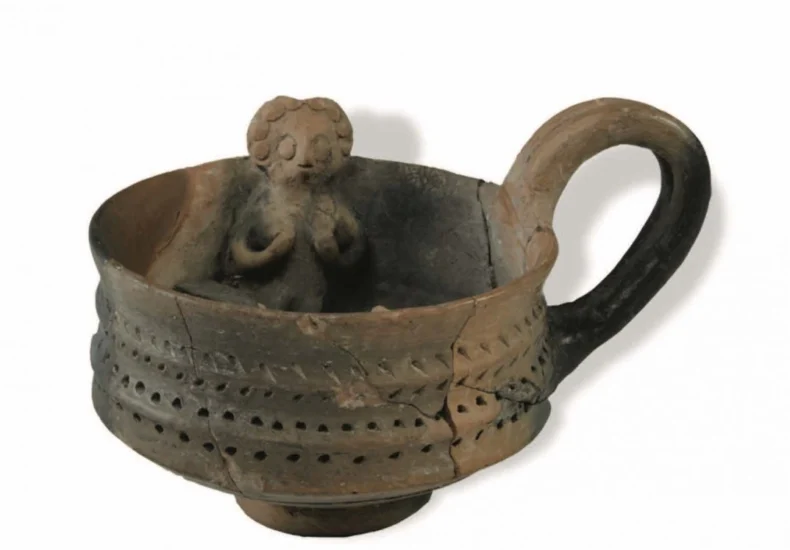
A Hittite Goddess Vessel from Eskiyapar and the Ritual of “Drinking the God”
The Hittites were among the earliest state-forming societies of Anatolia, shaping their political power alongside an exceptionally complex religious system. Their rituals, preserved on thousands of cuneiform tablets, describe ceremonies rich in symbolism—many of which have long remained difficult to visualize. A small ceramic vessel unearthed at Eskiyapar now offers a rare and tangible glimpse into one of these elusive practices.
The object dates to the Old Hittite period and comes from Eskiyapar, near modern-day Alaca in central Türkiye. At first sight, it appears to be a simple cup. But its true significance emerges only when one looks inside.
A Sacred Space Shaped Inside a Cup
The interior of the vessel is carefully arranged to resemble a miniature sacred setting. At its center stands a small table, upon which a loaf of bread is depicted. Dominating the scene is a female deity, shown grasping her breasts—a gesture closely associated in Hittite imagery with fertility, nourishment, and divine abundance.
She wears a solar disk crown, a symbol reserved in Hittite culture for goddesses and queens. This is not ornamental pottery. It is a ritual narrative rendered in clay.
📣 Our WhatsApp channel is now LIVE! Stay up-to-date with the latest news and updates, just click here to follow us on WhatsApp and never miss a thing!!
Giving Form to the Ritual of “Drinking the God”
Hittite ritual texts frequently mention offerings of flat, disk-shaped bread presented to the gods. Among the most striking expressions found in these texts is the act referred to as “drinking the god.” For decades, scholars have debated what this phrase meant in practice.
The Eskiyapar vessel provides a compelling visual answer. According to interpretations based on Hittite ritual studies, the scene inside the cup likely represents this very act. The bread appears to be offered both on the altar and on the ground, mirroring descriptions found in the texts. At present, this vessel stands as the only known archaeological object that visually conveys this ritual with such clarity.
Eight Disks, One Goddess — A Unique Crown
What makes the Eskiyapar vessel truly exceptional is the goddess’s crown. While solar disk headgear is well attested in Hittite art, this example includes an unprecedented feature: eight small disks arranged around the main solar disk.
This detail is unique in Hittite iconography. In Hittite visual culture, no element is accidental. Every detail carries meaning, often compressing complex religious concepts into a single image. The presence of eight additional disks strongly suggests a deliberate symbolic message.
Arinna, Tahurpa, and the Eight Goddesses
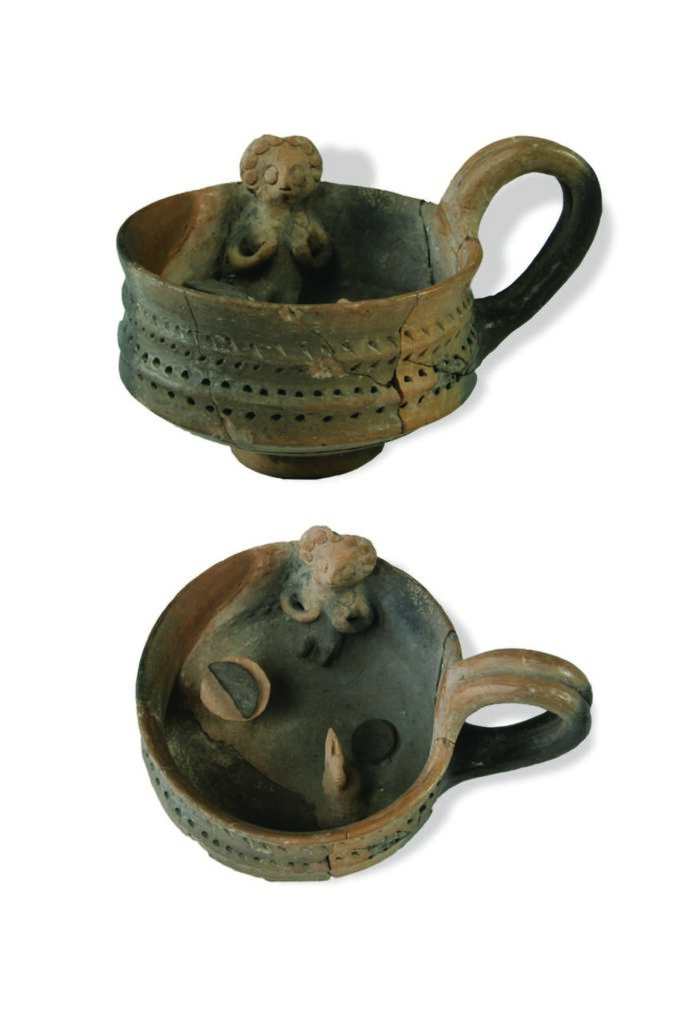
The scene inside the vessel, with its goddess figure and bread offerings, is commonly understood as a rare material depiction of the Hittite ritual called “drinking the god.”
That message becomes clearer when read alongside Hittite textual sources. According to ritual descriptions, the Hittite queen conducted ceremonies in the city of Tahurpa in honor of the Sun Goddess of Arinna. Crucially, offerings were not made to a single deity alone, but to eight associated goddesses.
Many scholars interpret these figures as deceased and deified Hittite queens. In this context, the eight small disks crowning the goddess in the Eskiyapar vessel take on clear significance. They likely represent these eight goddesses, transforming the vessel into a compact visual expression of a state-level cult ceremony. The figure inside the cup may therefore be identified as the Mother Goddess of Arinna herself.
Why Eskiyapar Is Central to the Story
The interpretation gains further strength from another find at Eskiyapar. In 1945, before systematic excavations began, a second goddess vessel was discovered at the site. Although broken and incomplete, it was published in American Journal of Archaeology 51 (1947). This vessel also depicts a goddess holding her breasts inside a cup.
Already in that early publication, scholars linked the object to the ritual of “drinking the god” and noted a striking feature: when held in the right hand, the vessel positions the user face-to-face with the goddess. This intimate interaction appears to be an intentional part of the ritual design.
Significantly, such goddess vessels have been found only at Eskiyapar. This suggests that both the ritual and the vessels themselves may represent a local religious tradition rather than a practice common across the entire Hittite world.
A Powerful Religious Center in Early Hittite Anatolia
Ongoing archaeological work may eventually confirm whether Eskiyapar corresponds to the city of Tahurpa mentioned in Hittite texts. Such a conclusion would also strengthen the association between Arinna and nearby Alacahöyük. Even without that final confirmation, one conclusion is already clear: Eskiyapar was not a marginal settlement, but a center with a strong and distinctive religious identity during the Old Hittite period.
Sometimes, understanding how the Hittites related to their gods does not require monumental temples or grand reliefs. Sometimes, it requires looking into a single cup—and recognizing the sacred world it was meant to hold.
This article is informed by archaeological interpretations published in the “Birth of Cities” dossier of Aktüel Arkeoloji Dergisi (Issue 78)together with current research on Hittite texts and iconography.
- A 1700-year-old statue of Pan unearthed during the excavations at Polyeuktos in İstanbul
- The granary was found in the ancient city of Sebaste, founded by the first Roman emperor Augustus
- Donalar Kale Kapı Rock Tomb or Donalar Rock Tomb
- Theater emerges as works continue in ancient city of Perinthos
- Urartian King Argishti’s bronze shield revealed the name of an unknown country

- The religious center of Lycia, the ancient city of Letoon
- Who were the Luwians?
- A new study brings a fresh perspective on the Anatolian origin of the Indo-European languages

- Perhaps the oldest thermal treatment center in the world, which has been in continuous use for 2000 years -Basilica Therma Roman Bath or King’s Daughter-
- The largest synagogue of the ancient world, located in the ancient city of Sardis, is being restored
Leave a Reply