
Massive Sardis Synagogue with Vast Mosaics Reveals Jewish Presence in Roman Anatolia
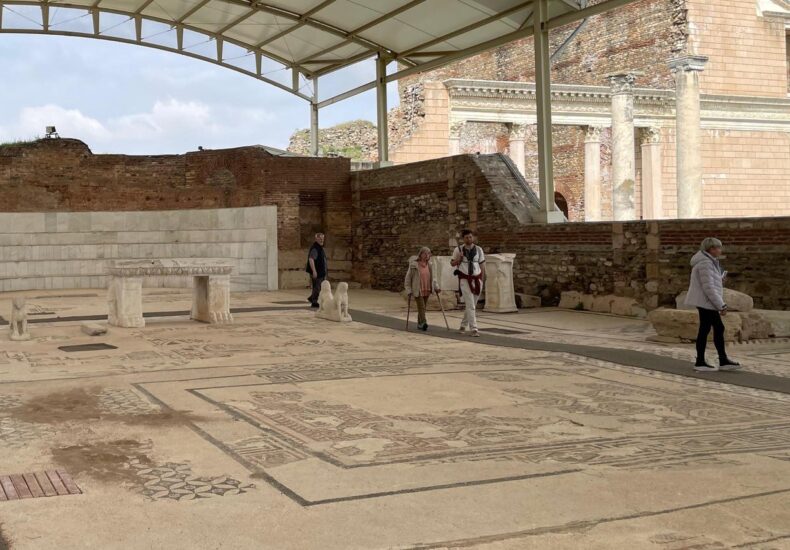
One of the largest synagogues of the ancient world still stands at Sardis—its vast mosaic floors stretching across nearly 1,400 square meters, quietly preserving the footprint of a once-powerful Jewish community in Roman Anatolia.
Set within one of the city’s most prominent public complexes, the structure does more than impress with its scale. It reveals a community that was not hidden, but fully embedded in the civic and social life of a major Roman city.
In statements shared with Türkiye Today, archaeologist Bahadır Yıldırım, assistant director of the Sardis excavations, noted that the building reflects a highly organized and visible Jewish presence during the 4th and 5th centuries A.D.—a period when Sardis remained a key urban center in western Anatolia.
Photo: Koray Erdoğan, Türkiye Today
The Sardis Synagogue Embedded in a Roman Public Complex
The placement of the synagogue is striking. Rather than standing apart, it was integrated directly into the city’s bath-gymnasium complex, one of the most important public spaces in Sardis. This was not a peripheral structure. It occupied a central and highly visible position.
📣 Our WhatsApp channel is now LIVE! Stay up-to-date with the latest news and updates, just click here to follow us on WhatsApp and never miss a thing!!
Archaeological evidence shows that visitors would have entered through a colonnaded forecourt, open at its center and framed by covered walkways. From there, the space opened into a monumental hall extending more than 50 meters in length.
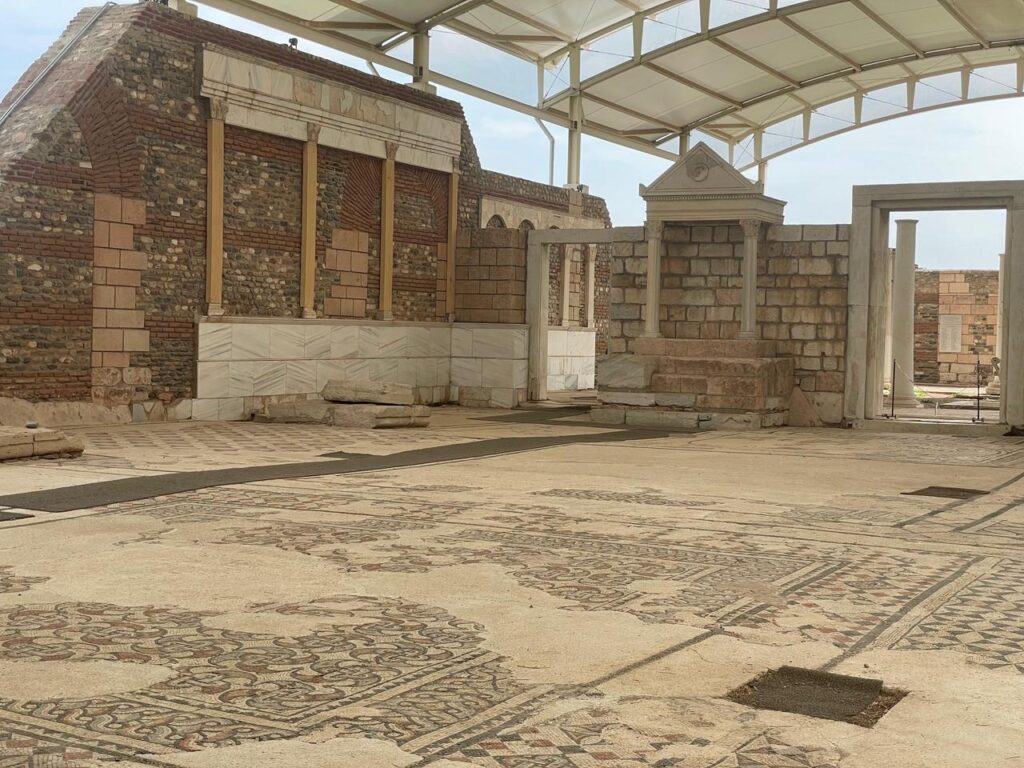
The scale is difficult to ignore. The building could accommodate close to 1,000 people—a figure that points to a large and established congregation.
Stone piers once supported a high roof rising approximately 14 meters above the floor. While the original roofing system has not survived, the internal divisions remain clearly visible today. A modern protective shelter now covers the structure, designed specifically to preserve its most fragile elements.
Mosaics and Ritual Features Inside the Ancient Synagogue at Sardis
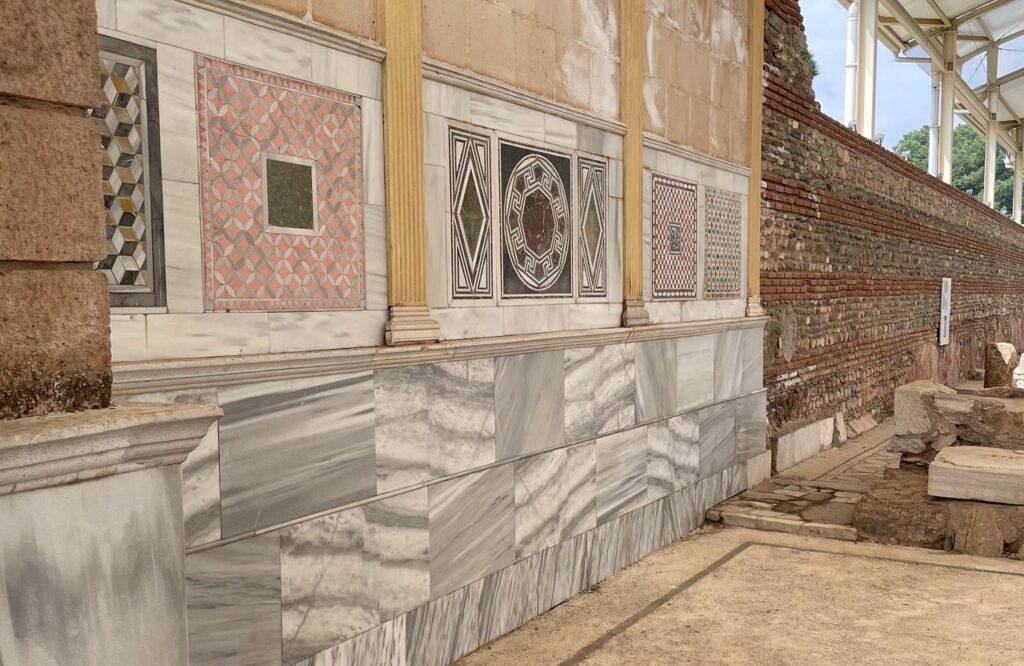
The defining feature of the building is its mosaic flooring. Covering nearly 1,400 square meters, these surfaces form one of the largest continuous mosaic programs known from any synagogue in the ancient world.
The decoration is notably restrained. Instead of figural imagery, the mosaics are composed almost entirely of geometric patterns, creating a visual environment that aligns with religious sensibilities while still demonstrating technical sophistication.
Near the entrance, archaeologists identified a ritual washing area, suggesting that purification practices were an integral part of the worship experience. In the forecourt, a large stone basin—likely functioning as a fountain—was supplied by clay pipes running beneath the floor, indicating a carefully designed water system.
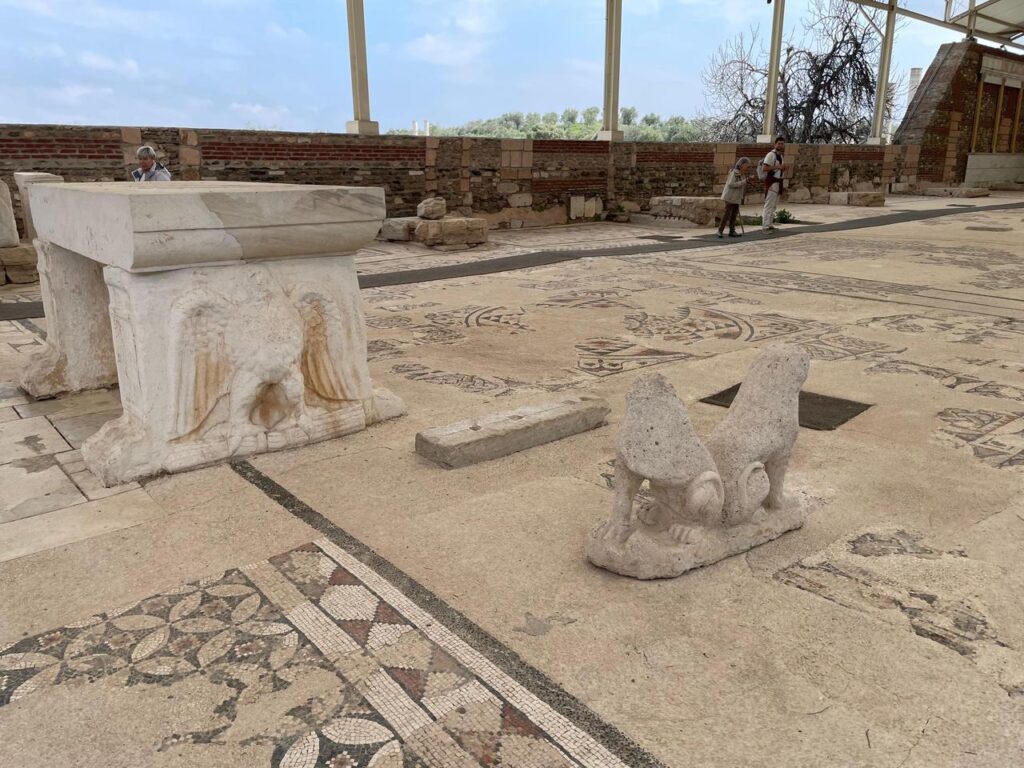
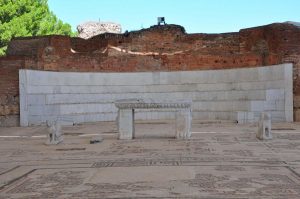
Inside the main hall, marble elements were introduced over time. Among them is a large lion-decorated marble table, believed to have been used during the reading of Torah scrolls. These scrolls were likely stored in shrines positioned at the far end of the building.
At the rear, an apse fitted with marble benches appears to have been reserved for community leaders. The layout makes one thing clear: this was not just a place of prayer. It was a structured communal space.
Inscriptions Point to Status and Integration
The synagogue also preserves written traces of the people who used it. Donor inscriptions, carved in Greek, record contributions from members of the local Jewish community.
Some of these individuals are identified as civic officials and council members—a detail that carries real weight. It suggests that the Jewish population of Sardis was not isolated from the broader society, but actively involved in its administrative and social life.
Another inscription refers to a figure described as a “teacher of wisdom,” offering a glimpse into the intellectual and religious leadership within the community.
Taken together, these details point to a group that was both economically capable and socially integrated.
Preservation, Restoration, and a Second Phase of Protection
The synagogue came to light during excavations in 1962, but its survival required immediate intervention. Early conservation efforts involved lifting the mosaics, reinforcing them, and returning them to their original positions. Architectural elements were partially reconstructed to help define the space.
That initial campaign was completed in 1973. However, exposure to environmental conditions gradually caused deterioration beneath the mosaic layers.
To address this, a new protective shelter was installed in 2021, allowing both conservation work and visitor access to continue. Restoration now proceeds gradually, section by section, with a focus on stabilizing the mosaic surfaces.
Sardis and the Wider Historical Landscape
The significance of the synagogue becomes clearer when viewed within the broader history of Sardis. Once the capital of the Lydian Kingdom, the city later remained an important center under Persian, Hellenistic, and Roman rule. It is also known as one of the Seven Churches of Asia, highlighting its role in early Christianity.
Yet the synagogue tells a parallel story—one of Jewish life flourishing within the same urban environment.
The building was eventually abandoned following a major earthquake in the early 7th century A.D., which affected much of the city. Despite this, the structure remains remarkably accessible today.
Visitors can still walk across its original mosaic floors, standing within a space that once hosted one of the most prominent Jewish communities of Roman Anatolia.
This is what sets Sardis apart. The synagogue is not just preserved—it is still readable. And through it, an entire layer of the ancient city’s social and religious life comes back into view.
- A 1700-year-old statue of Pan unearthed during the excavations at Polyeuktos in İstanbul
- The granary was found in the ancient city of Sebaste, founded by the first Roman emperor Augustus
- Donalar Kale Kapı Rock Tomb or Donalar Rock Tomb
- Theater emerges as works continue in ancient city of Perinthos
- Urartian King Argishti’s bronze shield revealed the name of an unknown country
- The religious center of Lycia, the ancient city of Letoon
- Who were the Luwians?
- A new study brings a fresh perspective on the Anatolian origin of the Indo-European languages

- Perhaps the oldest thermal treatment center in the world, which has been in continuous use for 2000 years -Basilica Therma Roman Bath or King’s Daughter-
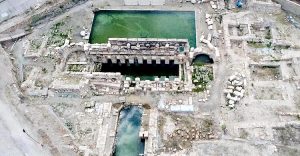
- The largest synagogue of the ancient world, located in the ancient city of Sardis, is being restored
Leave a Reply