
At Nysa, the Road to Knowledge Emerges Again: 1,800-Year-Old Steps to a Roman Library Revealed
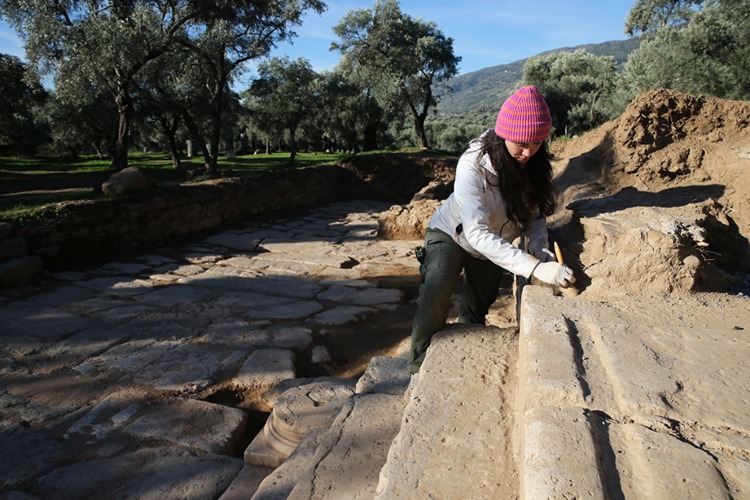
In the early hours of the excavation season, as the soil was carefully lifted from a Roman street in western Anatolia, a forgotten route resurfaced — one that once led directly to knowledge itself. At Nysa Ancient City, archaeologists have uncovered a set of marble steps dating back roughly 1,800 years, revealing how ancient visitors ascended from the city’s main thoroughfare to one of the best-preserved libraries in the region.
A City Built for Learning
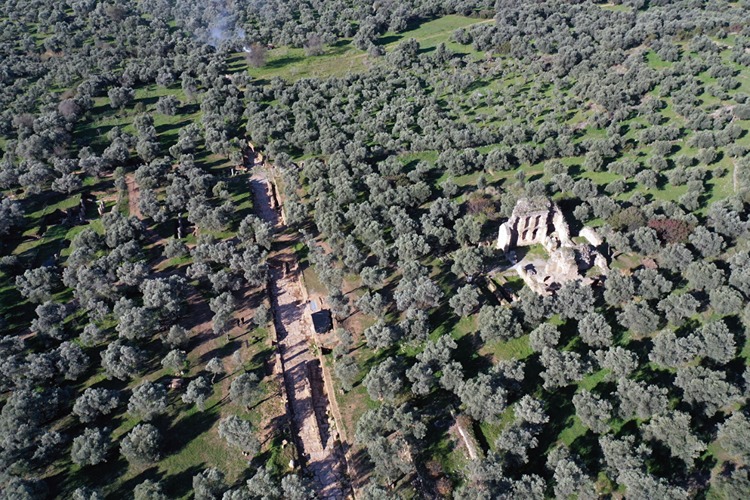
Nysa, founded more than 2,300 years ago, occupies a dramatic landscape, stretching across both sides of a narrow valley — a feature that earned it the ancient description of a “double-sided city.” Excavations at the site are led by Prof. Dr. Serdar Hakan Öztaner of Ankara University’s Faculty of Language, History and Geography.
The city’s urban fabric reflects its status as a Roman-era center of education and culture. Monumental structures such as the theater, stadion, gymnasium, agora, council buildings, and the Sanctuary of Akharaka frame a settlement designed not merely for residence, but for intellectual life.
Ancient geographer Strabo famously studied in Nysa — a detail that continues to shape how archaeologists interpret the city’s architectural priorities.
📣 Our WhatsApp channel is now LIVE! Stay up-to-date with the latest news and updates, just click here to follow us on WhatsApp and never miss a thing!!
The Missing Link Between Street and Library
Until recently, one crucial question remained unanswered: How exactly did people reach the library from the city’s main street?
That question was resolved during the 2025 excavation season.
“When our excavations along the main street reached the axis of the library, we uncovered the staircase connecting the two,”
Prof. Dr. Öztaner explains.
“We knew the library well, but we did not know how the two-meter elevation difference from the street was overcome.”
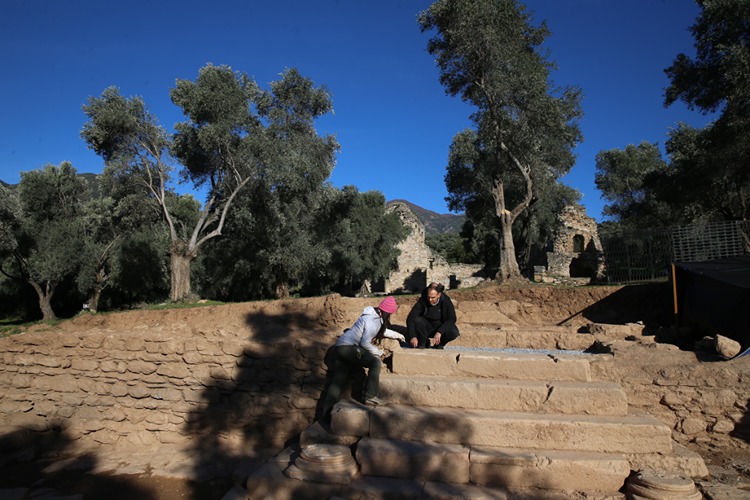
The newly revealed structure consists of five marble steps, leading upward from the Roman street to a marble-paved courtyard directly in front of the library. The staircase sits precisely at the center of the architectural block on which the library stands, confirming that this was the primary ceremonial approach to the building.
Built Into the City, Not Apart From It
Archaeological evidence indicates that the library itself was constructed around AD 130, while the city’s street system dates back to the reign of Augustus. This means the staircase was added in the 2nd century AD, deliberately integrating the library into an already functioning urban network.
“The steps show us that the library was not an isolated monument,”
Öztaner notes.
“It was physically connected to the city’s main artery. Knowledge here was meant to be accessible.”
This architectural choice underscores the civic role of learning in Roman Nysa — a place where education was woven directly into daily urban movement.
One of Western Anatolia’s Best-Preserved Libraries
The Nysa Library was built after the renowned Library of Celsus, yet it stands today as one of the best-preserved ancient libraries in western Anatolia.
Ancient sources describe the building as containing sixteen book niches, which once held important handwritten texts of the Roman world. These were not symbolic spaces, but active repositories of knowledge — manuscripts read, copied, and studied by generations of scholars.
Today, visitors still pause in front of the structure, drawn not only by its preservation, but by what it represents.
More Than Steps, a Statement
The newly uncovered staircase is a modest structure in size, yet powerful in meaning. Rising directly from the main street to the library courtyard, it embodies a clear message from the Roman city planners of Nysa: learning belonged at the heart of the city.
Eighteen centuries later, that message is once again visible — carved in stone, aligned with the street, and leading unmistakably toward knowledge.
- A 1700-year-old statue of Pan unearthed during the excavations at Polyeuktos in İstanbul
- The granary was found in the ancient city of Sebaste, founded by the first Roman emperor Augustus
- Donalar Kale Kapı Rock Tomb or Donalar Rock Tomb
- Theater emerges as works continue in ancient city of Perinthos
- Urartian King Argishti’s bronze shield revealed the name of an unknown country
- The religious center of Lycia, the ancient city of Letoon
- Who were the Luwians?
- A new study brings a fresh perspective on the Anatolian origin of the Indo-European languages

- Perhaps the oldest thermal treatment center in the world, which has been in continuous use for 2000 years -Basilica Therma Roman Bath or King’s Daughter-
- The largest synagogue of the ancient world, located in the ancient city of Sardis, is being restored
Leave a Reply