
Fishing Net Snags Possible Ancient Jar as Water Levels Drop in Lake İznik
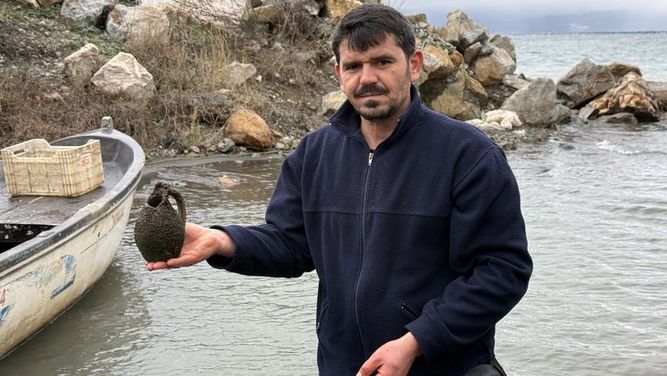
A routine morning on Lake İznik turned unexpectedly archaeological this week, when a fisherman’s net surfaced not with carp or perch—but with what appears to be a historic clay jar.
The incident occurred along the shores of Göllüce, a neighborhood on the western edge of the lake in Bursa, northwestern Türkiye. As drought conditions continue to lower the water level, previously submerged sections of the lakebed are increasingly exposed. This time, the retreating waters may have revealed more than mud and reeds.
A Fisherman’s Unusual Catch
Osman Erim, who has worked these waters for more than three decades, noticed something unusual as he began hauling in his nets shortly after sunrise.
The object tangled in the mesh did not resemble debris or driftwood. Nor was it marine waste. Sensing it was something different, Erim steered his small boat back toward shore to inspect it more closely.
📣 Our WhatsApp channel is now LIVE! Stay up-to-date with the latest news and updates, just click here to follow us on WhatsApp and never miss a thing!!
What he found was a clay vessel—apparently intact and bearing the form of a traditional storage jar.
“I’ve lived in Göllüce all my life. I’ve been fishing since I was a child,” Erim said. “We cast our nets as usual, and this object was caught in them. I couldn’t understand what it was at first. We immediately informed the gendarmerie and the museum authorities. I’ve been fishing for 30–35 years, and this is the first time something like this has happened.”
Local residents quickly gathered along the shoreline as word spread through the neighborhood.
Authorities Respond, Scientific Analysis Pending
Following Erim’s report, teams from the local gendarmerie and the regional museum directorate were dispatched to the site. After official documentation procedures were completed, the jar was transferred to museum authorities for examination.
At this stage, specialists have not confirmed the vessel’s date or function. Archaeological analysis will determine whether the jar belongs to the Hellenistic, Roman, Byzantine, or later Ottoman periods—all of which are historically attested in and around İznik.
Officials emphasized that scientific study will clarify both the chronology and intended use of the object. They also reiterated an important point: citizens encountering potential heritage material should immediately notify authorities rather than attempt to keep or move the items independently.
Lake İznik: A Submerged Archive of Civilizations
Lake İznik is no ordinary body of water. In antiquity, the nearby city of Nicaea—modern İznik—was one of the most significant urban centers in northwestern Anatolia. It hosted the First and Seventh Ecumenical Councils during the Byzantine period and was earlier a prominent Hellenistic and Roman settlement.
In 2014, aerial surveys famously revealed the remains of a submerged Byzantine basilica beneath the lake’s surface, believed to date to the 4th or 5th century CE. Since then, İznik has increasingly drawn attention from underwater archaeologists and cultural heritage experts.
Lower water levels in recent years have intermittently exposed architectural fragments, pottery sherds, and structural remains along the lake’s perimeter. While climate stress poses environmental challenges, it also alters the visibility of submerged cultural layers—sometimes dramatically.
The jar discovered this week may be linked to shoreline activity such as trade, storage, or transport. Large ceramic vessels were widely used throughout Anatolia for storing grain, oil, wine, and water. If the piece proves ancient, it could represent domestic use, commercial storage, or even ritual deposition.
Yet speculation must wait.
Between Drought and Discovery
Water-level fluctuations are not new to Lake İznik, but recent declines have been pronounced. As shorelines recede, archaeological material that has remained underwater for centuries can emerge—sometimes intact, sometimes fragmented.
Such finds, however accidental, underscore the importance of public awareness in heritage protection. The quick action taken by Osman Erim prevented potential loss or damage to the object and ensured it entered official conservation channels.
For now, the jar rests in the custody of museum specialists. Laboratory analysis will assess clay composition, manufacturing technique, and any surface traces that might indicate its age or function.
Whether the vessel dates back two centuries or two millennia, the episode serves as a reminder: Anatolia’s lakes, fields, and coastlines remain layered with history.
Cover Image Credit: IHA
- A 1700-year-old statue of Pan unearthed during the excavations at Polyeuktos in İstanbul
- The granary was found in the ancient city of Sebaste, founded by the first Roman emperor Augustus
- Donalar Kale Kapı Rock Tomb or Donalar Rock Tomb
- Theater emerges as works continue in ancient city of Perinthos
- Urartian King Argishti’s bronze shield revealed the name of an unknown country
- The religious center of Lycia, the ancient city of Letoon
- Who were the Luwians?

- A new study brings a fresh perspective on the Anatolian origin of the Indo-European languages

- Perhaps the oldest thermal treatment center in the world, which has been in continuous use for 2000 years -Basilica Therma Roman Bath or King’s Daughter-
- The largest synagogue of the ancient world, located in the ancient city of Sardis, is being restored
Leave a Reply