
Greek-Inscribed Late Antique Mosaic Unearthed in Türkiye’s Hatay Province
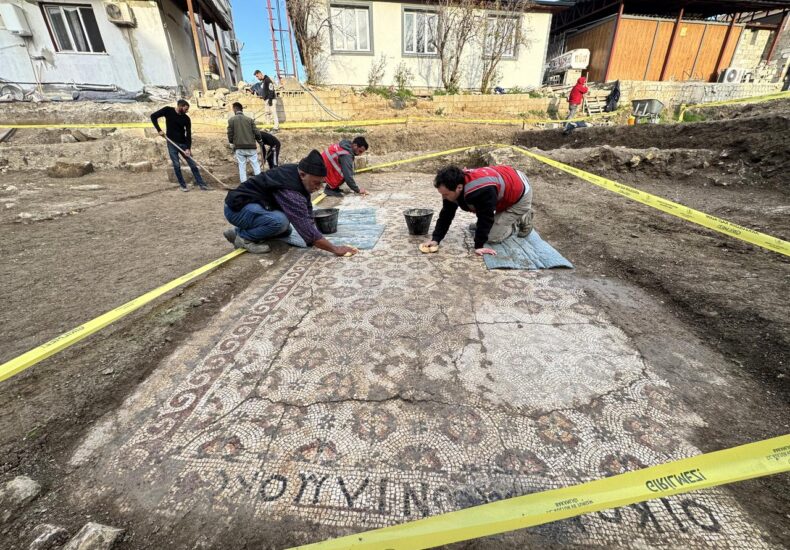
A Late Antique floor mosaic bearing a Greek inscription has been uncovered in southern Türkiye’s Hatay province during foundation excavation work at a site severely damaged by the February 6, 2023 earthquakes. The discovery once again highlights the extraordinary archaeological depth of Antakya, ancient Antioch, even amid large-scale post-disaster reconstruction.
The mosaic was found in the Masuklu neighborhood of Antakya, where a three-story residential building collapsed during the earthquakes centered in Kahramanmaraş. After the debris was cleared, construction teams began digging foundations for a new structure. Excavation work was immediately halted when workers encountered the ancient mosaic floor just beneath the surface.
Late Antique Mosaic Bearing a Greek Inscription
A rescue excavation was launched in March under the supervision of the Hatay Archaeology Museum. Archaeological investigations at the site have so far revealed three separate mosaic areas, including a single-piece floor mosaic measuring 17.5 meters in length.
📣 Our WhatsApp channel is now LIVE! Stay up-to-date with the latest news and updates, just click here to follow us on WhatsApp and never miss a thing!!
Archaeologist Ozan Demir stated that mosaics of this scale and craftsmanship were not typical features of ordinary domestic architecture in antiquity. Such floors, he noted, usually belonged to high-status residences, suggesting that the building once housed a socially prominent individual or family.

Demir also emphasized that the mosaic shows clear traces of ancient repairs, indicating long-term use and careful maintenance rather than abandonment. These repair marks provide valuable evidence for how Late Antique communities preserved and reused elite domestic spaces over extended periods.
Excavation work is currently being carried out by a team of two archaeologists and eight workers. In addition to documenting the mosaics, the team is working to identify surrounding architectural remains in order to reconstruct the building’s original layout and function.
Greek-Inscribed Late Antique Mosaic from Ancient Antioch
Archaeologist Mert Nalbantoglu underlined the importance of the mosaic’s excellent state of preservation, noting that the Greek inscription significantly enhances its historical value. Both the inscription and the geometric patterns are characteristic of Late Antique floor decoration dating from the fourth to sixth centuries A.D., particularly within the Eastern Mediterranean cultural sphere.
From Rescue Excavation to Museum Conservation
Once conservation and documentation are completed, the mosaic is expected to be transferred to the Hatay Archaeology Museum in 2026. After work on the main mosaic concludes, excavation teams will proceed with detailed investigations of the two additional mosaics identified within the same plot.
Modern Antakya, known in antiquity as Antioch, was one of the most important urban centers of the Roman and Byzantine worlds. Renowned for its mosaic tradition, the city continues to reveal new archaeological layers beneath its modern fabric—often unexpectedly, even in the aftermath of disaster-driven rebuilding efforts.
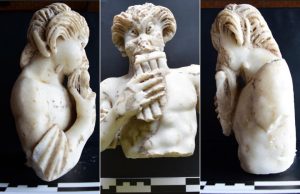
- A 1700-year-old statue of Pan unearthed during the excavations at Polyeuktos in İstanbul
- The granary was found in the ancient city of Sebaste, founded by the first Roman emperor Augustus
- Donalar Kale Kapı Rock Tomb or Donalar Rock Tomb
- Theater emerges as works continue in ancient city of Perinthos
- Urartian King Argishti’s bronze shield revealed the name of an unknown country
- The religious center of Lycia, the ancient city of Letoon
- Who were the Luwians?
- A new study brings a fresh perspective on the Anatolian origin of the Indo-European languages

- Perhaps the oldest thermal treatment center in the world, which has been in continuous use for 2000 years -Basilica Therma Roman Bath or King’s Daughter-
- The largest synagogue of the ancient world, located in the ancient city of Sardis, is being restored
Leave a Reply