
Late Roman Mosaic with Protective “Solomon’s Knot” Discovered at Ancient Smyrna
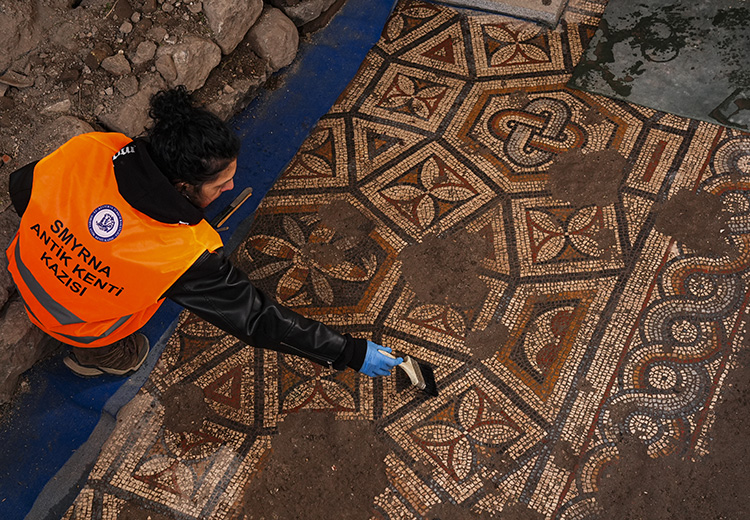
Archaeologists working in the center of modern İzmir have uncovered a rare Late Roman mosaic floor featuring the Solomon’s knot, a symbol long associated with protection against misfortune and the evil eye. The discovery was made during ongoing excavations at Smyrna, one of western Anatolia’s most important Greco-Roman urban centers.
Found along Smyrna’s main ancient thoroughfare
The mosaic was revealed along the North Street of the Smyrna Agora, an area known in antiquity as one of the city’s principal arteries. Measuring approximately 3 by 4 meters, the floor is decorated with interlocking twelve-sided geometric panels that visually guide the viewer toward a central emblem: the Solomon’s knot.

Late Roman architecture beneath the agora
According to the excavation director, Akın Ersoy of İzmir Katip Çelebi University, Smyrna was rebuilt as a planned city after the era of Alexander the Great. Excavations today focus primarily on the agora and theater, where multiple layers of urban life overlap. The newly uncovered mosaic belongs to a structure dated to the Late Roman period, roughly between the 4th and 6th centuries CE.
A mosaic room with an uncertain function
At present, archaeologists have identified the space as a mosaic-floored room. Whether the building functioned as a private residence or a public space remains uncertain. Such ambiguity is common in Late Antique urban contexts, where richly decorated mosaic floors appear in both domestic and communal settings across Anatolia.
📣 Our WhatsApp channel is now LIVE! Stay up-to-date with the latest news and updates, just click here to follow us on WhatsApp and never miss a thing!!
Protective symbols against envy and the evil eye
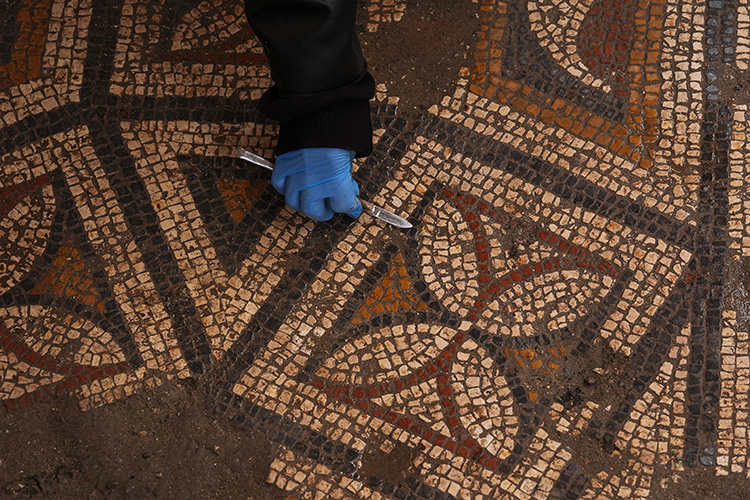
Beyond its craftsmanship, the mosaic is notable for its symbolic language. Alongside vegetal and geometric motifs, the Solomon’s knot occupies the visual center and is accompanied by small cross motifs. Ersoy explains that such symbols were deliberately incorporated into floors and entrances to ward off jealousy, envy, and harmful forces—beliefs often summarized under the concept of the evil eye.
From pre-Christian symbolism to Late Antique belief systems
While the Solomon’s knot predates Christianity, its coexistence with cross motifs illustrates how earlier decorative traditions were adapted and reinterpreted within later religious frameworks. The mosaic reflects a continuity of symbolic meaning rather than a sharp cultural break in Late Antique Anatolia.
Reuse of the mosaic in the nineteenth century
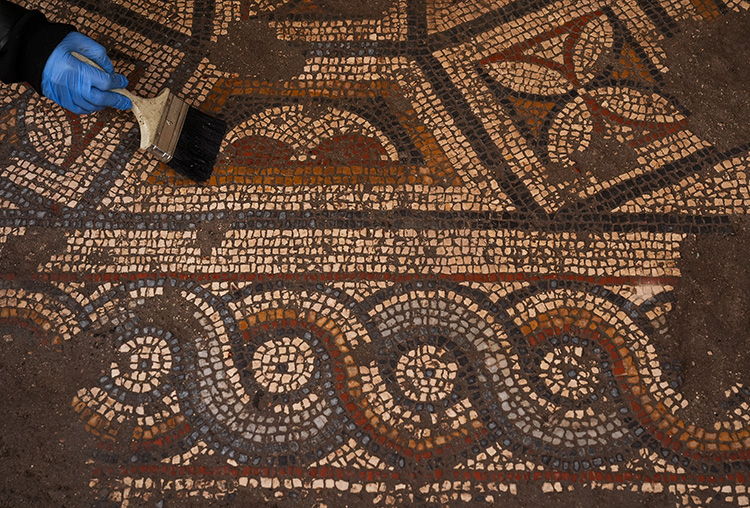
Archaeological evidence shows that the mosaic floor did not fall out of use after antiquity. In the nineteenth century, when the area was reused by nearby residential buildings or a non-Muslim hospital complex, the ancient floor was reopened and incorporated into new structures. Walls from this later phase were laid directly over the mosaic, suggesting that it was intentionally admired and reused nearly 1,500 years after its creation.
Expanding excavations and future discoveries
Excavations at Smyrna Agora are set to expand in the coming seasons. Ersoy notes that as work continues in 2026, additional rooms connected to the mosaic space may come to light. Each new discovery further underscores Smyrna’s role as a layered urban landscape shaped by architecture, belief, and daily life across millennia.
- A 1700-year-old statue of Pan unearthed during the excavations at Polyeuktos in İstanbul
- The granary was found in the ancient city of Sebaste, founded by the first Roman emperor Augustus
- Donalar Kale Kapı Rock Tomb or Donalar Rock Tomb
- Theater emerges as works continue in ancient city of Perinthos
- Urartian King Argishti’s bronze shield revealed the name of an unknown country
- The religious center of Lycia, the ancient city of Letoon
- Who were the Luwians?
- A new study brings a fresh perspective on the Anatolian origin of the Indo-European languages

- Perhaps the oldest thermal treatment center in the world, which has been in continuous use for 2000 years -Basilica Therma Roman Bath or King’s Daughter-
- The largest synagogue of the ancient world, located in the ancient city of Sardis, is being restored
Leave a Reply