
Monumental Hellenistic Goddess Head Unearthed in Metropolis: Early Analysis Suggests a Link to Hestia
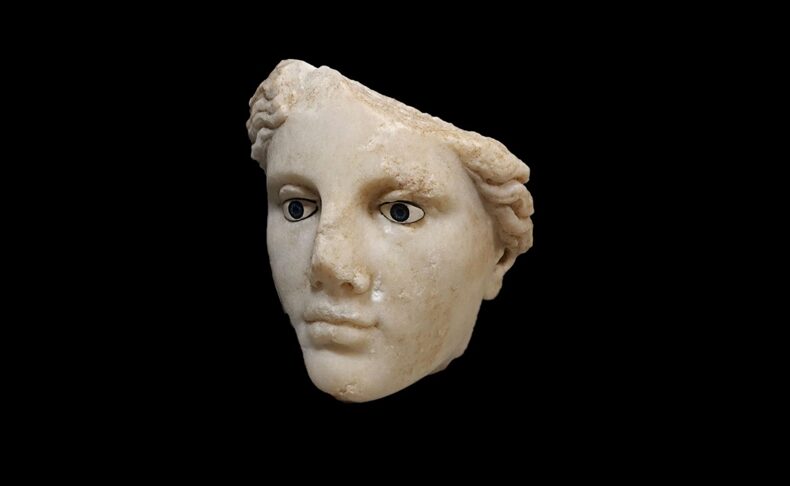
The ancient city of Metropolis, set among the orchards and gentle hills of Izmir’s Torbalı district, has delivered one of its most impressive finds in recent years. Archaeologists working in a structure identified as a commercial building have uncovered the finely carved head of a monumental marble statue—a discovery that may redefine what is known about the city’s sculptural traditions during the Hellenistic period.
The head, remarkably preserved despite its long burial, displays the hallmarks of high-skill craftsmanship: deeply cut hair locks, balanced facial geometry, and a commanding expression that suggests it once belonged to a large, public statue rather than a domestic votive piece. For a city historically known as the “City of the Mother Goddess,” the find resonates with a familiar religious landscape—but this time with new detail and artistic nuance.
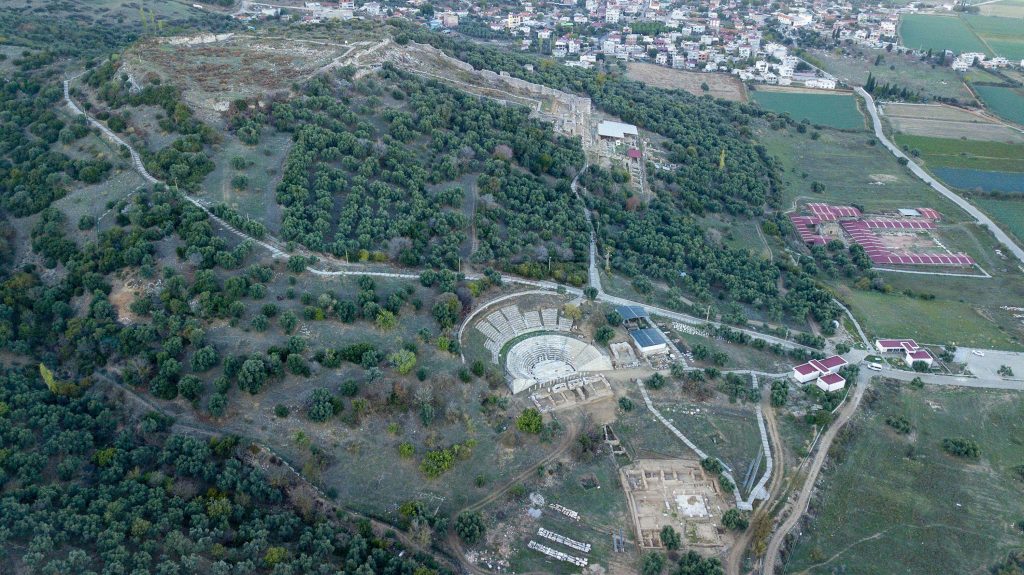
Excavations at Metropolis are carried out under the direction of Prof. Dr. Serdar Aybek of Dokuz Eylül University, within the scope of the Ministry of Culture and Tourism’s “Heritage to the Future” program and with support from the Sabancı Foundation. Although the site contains settlement traces extending back to the Neolithic, its most distinctive urban and artistic identity flourished during the Hellenistic centuries.
Evidence of an Elaborate Technique: Eyes Prepared for Stone Inlay
Shortly after the discovery, restorer Didem Taner undertook a detailed cleaning of the piece, revealing a striking feature. The area of the pupil had been intentionally hollowed out—an indication that the sculpture was designed to receive colored stones. Similar inlay techniques are known from prestigious workshops across the Aegean, suggesting that Metropolis was in contact with major artistic centers or perhaps maintained its own skilled atelier capable of executing high-quality monumental works.
📣 Our WhatsApp channel is now LIVE! Stay up-to-date with the latest news and updates, just click here to follow us on WhatsApp and never miss a thing!!
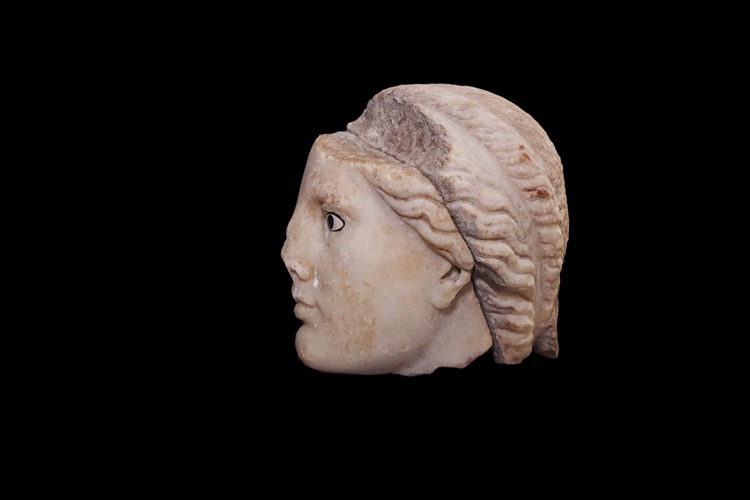
The head was carved in two separate blocks that were later fitted together with near-mathematical precision. This approach, widely favored by Hellenistic sculptors, enabled artists to construct statues that were both large in scale and exceptionally refined in their detail.
According to Prof. Aybek, “The craftsmanship, scale, and structural features indicate that this head belonged to a monumental statue. It offers rare and valuable insights into the sculptural production of Metropolis during the Hellenistic period.”
A Strong Candidate: Hestia, Goddess of the Hearth
Attention soon turned to a possibility that has intrigued researchers for years. During earlier excavations in the Council House, a torso believed to represent Hestia, the goddess of the hearth and civic unity, had been found. The newly unearthed head matches the torso in both scale and stylistic character, raising the likelihood that the two fragments once belonged to the same statue.
Restorer Taner Özgür recently performed an experimental “gaze reconstruction,” digitally simulating the statue’s original appearance with inlaid eyes. The resulting image offered a vivid glimpse into how the sculpture might have dominated the political and ritual landscape of Metropolis two millennia ago.
If confirmed, the reconstruction would represent one of the most complete Hellenistic goddess statues discovered in western Türkiye in recent decades.
A Window Into Metropolis’ Artistic Identity
Metropolis occupies a cultural crossroads where Anatolian religious traditions met the artistic ideals of the Hellenistic world. Although the site has yielded public buildings, inscriptions, and ritual spaces in abundance, large-scale deity sculptures remain exceptionally rare. This discovery therefore fills a significant gap in understanding how the city projected religious and political authority through art.
The newly uncovered head suggests that Metropolis did not merely import sculpture but participated directly in the aesthetic and technical networks of the wider Aegean. Scholars believe the find may also help clarify regional workshop practices and the transmission of sculptural techniques across western Anatolia.
As conservation progresses, the statue is expected to become one of the emblematic pieces of Metropolis—both for its artistry and for the broader historical insights it unlocks.
- A 1700-year-old statue of Pan unearthed during the excavations at Polyeuktos in İstanbul
- The granary was found in the ancient city of Sebaste, founded by the first Roman emperor Augustus
- Donalar Kale Kapı Rock Tomb or Donalar Rock Tomb
- Theater emerges as works continue in ancient city of Perinthos
- Urartian King Argishti’s bronze shield revealed the name of an unknown country
- The religious center of Lycia, the ancient city of Letoon
- Who were the Luwians?
- A new study brings a fresh perspective on the Anatolian origin of the Indo-European languages

- Perhaps the oldest thermal treatment center in the world, which has been in continuous use for 2000 years -Basilica Therma Roman Bath or King’s Daughter-
- The largest synagogue of the ancient world, located in the ancient city of Sardis, is being restored
Leave a Reply