
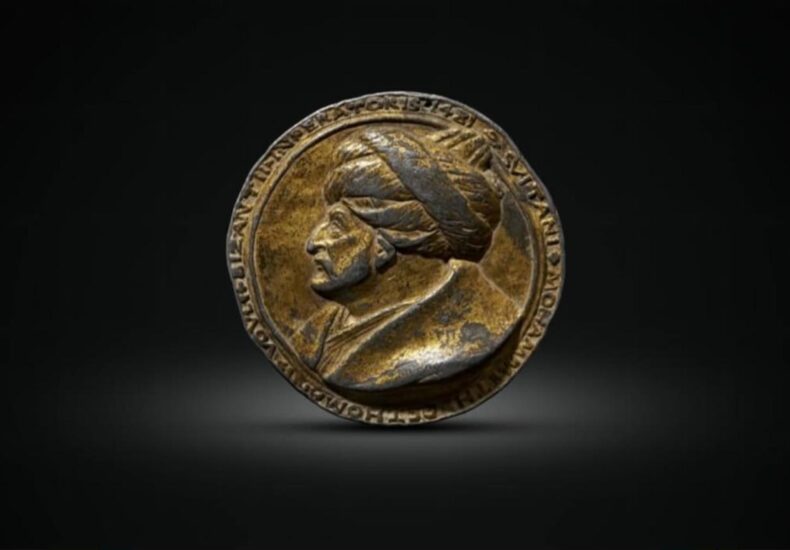
Renaissance Medallion of Mehmed the Conqueror to Headline Dubai Auction
A rare Renaissance portrait of Mehmed II—the Ottoman ruler who reshaped the course of world history—will soon take center stage at a high-profile auction in Dubai. Created in 1481 by the Italian artist Constanzo da Ferrara, the medallion is considered one of the most exceptional cross-cultural artworks linking Renaissance Europe with the Ottoman court.
What makes the piece especially compelling is not only its age, but the historical moment it represents: a time when artistic exchange between Italy and Istanbul reached an unusual level of sophistication.
A Portrait Born from Diplomacy and Power
The medallion traces its origins to a diplomatic initiative between the Kingdom of Naples and the Ottoman Empire. Historical accounts indicate that King Ferdinand of Naples dispatched Constanzo da Ferrara to Istanbul, where he worked under the patronage of Mehmed II.
The result was more than a simple likeness. It became a symbolic object—an artistic negotiation between two powerful worlds. The bronze casting, believed to be the earliest version of the work, features a refined gilded surface produced using the Ottoman “tombak” technique, a method that gives metal a rich, gold-like appearance.
📣 Our WhatsApp channel is now LIVE! Stay up-to-date with the latest news and updates, just click here to follow us on WhatsApp and never miss a thing!!
This fusion of Italian craftsmanship and Ottoman aesthetics reflects a rarely documented dimension of 15th-century political culture: rulers commissioning foreign artists to project authority through visual language.
Rarity and Known Parallels
Although the medallion is often described as unique, archival references suggest that a small number of related examples were produced. Today, only a handful are known to survive.
One comparable piece entered public ownership in 2022 when it was acquired by the Istanbul Metropolitan Municipality. The remaining examples are likewise connected to Istanbul, reinforcing the city’s central role in the object’s history.
Still, the version now heading to auction stands apart due to its condition, provenance, and status as an early cast.
Ottoman Art Gains Global Momentum
The upcoming sale, organized by Arthill, reflects a broader trend: the rising international demand for Ottoman-era artifacts.
Recent auctions have demonstrated growing interest in objects tied to imperial identity—ranging from jewelry and ceremonial items to calligraphy and metalwork bearing the distinctive “tughra,” the sultans’ emblematic signature.
Collectors are no longer limited to regional markets. Institutions and private buyers from Europe, the Gulf, and North America are increasingly competing for works that embody the cultural and political legacy of the Ottoman Empire.
Major institutions such as the British Museum, the Louvre, and the Metropolitan Museum of Art continue to shape global awareness of Ottoman art, while specialized displays—like the Turkish collections at the Rijksmuseum—highlight its international resonance.
More Than an Object: A Cultural Statement
According to Arthill’s leadership, collections like this are not assembled merely for commercial purposes. They are framed as efforts to preserve and reinterpret cultural memory.
The medallion of Mehmed II fits squarely into that vision. It is not just a Renaissance artifact, nor solely an Ottoman object. It stands at the intersection of two artistic traditions, capturing a moment when political ambition, diplomacy, and artistic innovation converged.
As bidding opens in Dubai, the piece is expected to attract significant attention—not only for its rarity, but for the historical narrative it carries.
Cover Image: A Renaissance bronze medallion portraying Ottoman Sultan Mehmed II, created by Italian artist Constanzo da Ferrara in 1481. Credit: Instagram/@seraysahinlerdemir
- A 1700-year-old statue of Pan unearthed during the excavations at Polyeuktos in İstanbul
- The granary was found in the ancient city of Sebaste, founded by the first Roman emperor Augustus
- Donalar Kale Kapı Rock Tomb or Donalar Rock Tomb
- Theater emerges as works continue in ancient city of Perinthos
- Urartian King Argishti’s bronze shield revealed the name of an unknown country

- The religious center of Lycia, the ancient city of Letoon
- Who were the Luwians?

- A new study brings a fresh perspective on the Anatolian origin of the Indo-European languages

- Perhaps the oldest thermal treatment center in the world, which has been in continuous use for 2000 years -Basilica Therma Roman Bath or King’s Daughter-
- The largest synagogue of the ancient world, located in the ancient city of Sardis, is being restored
Leave a Reply